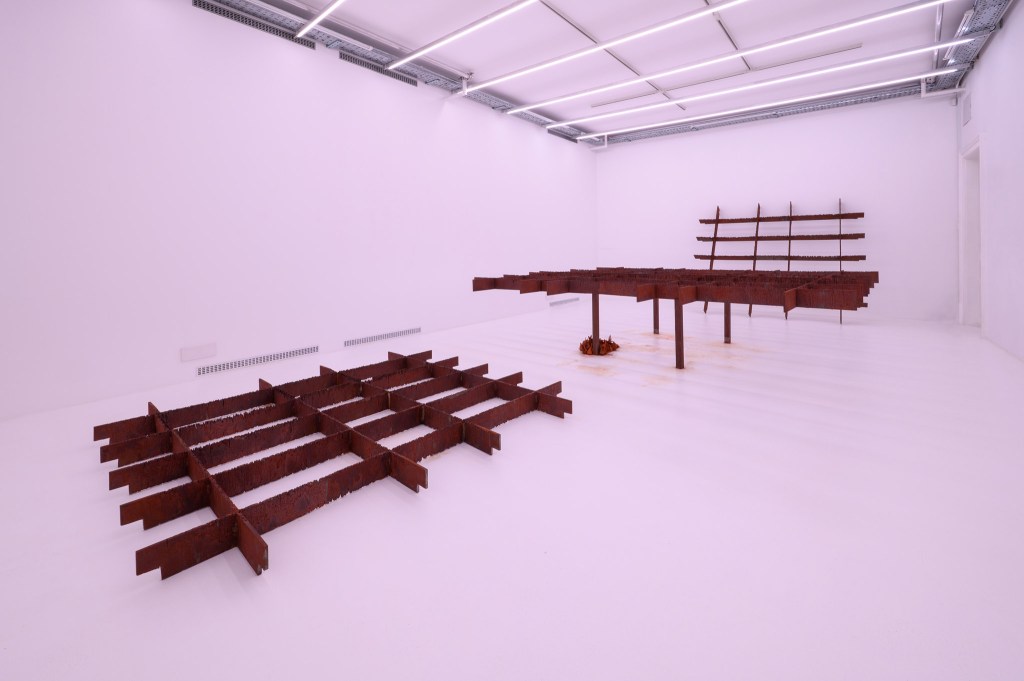
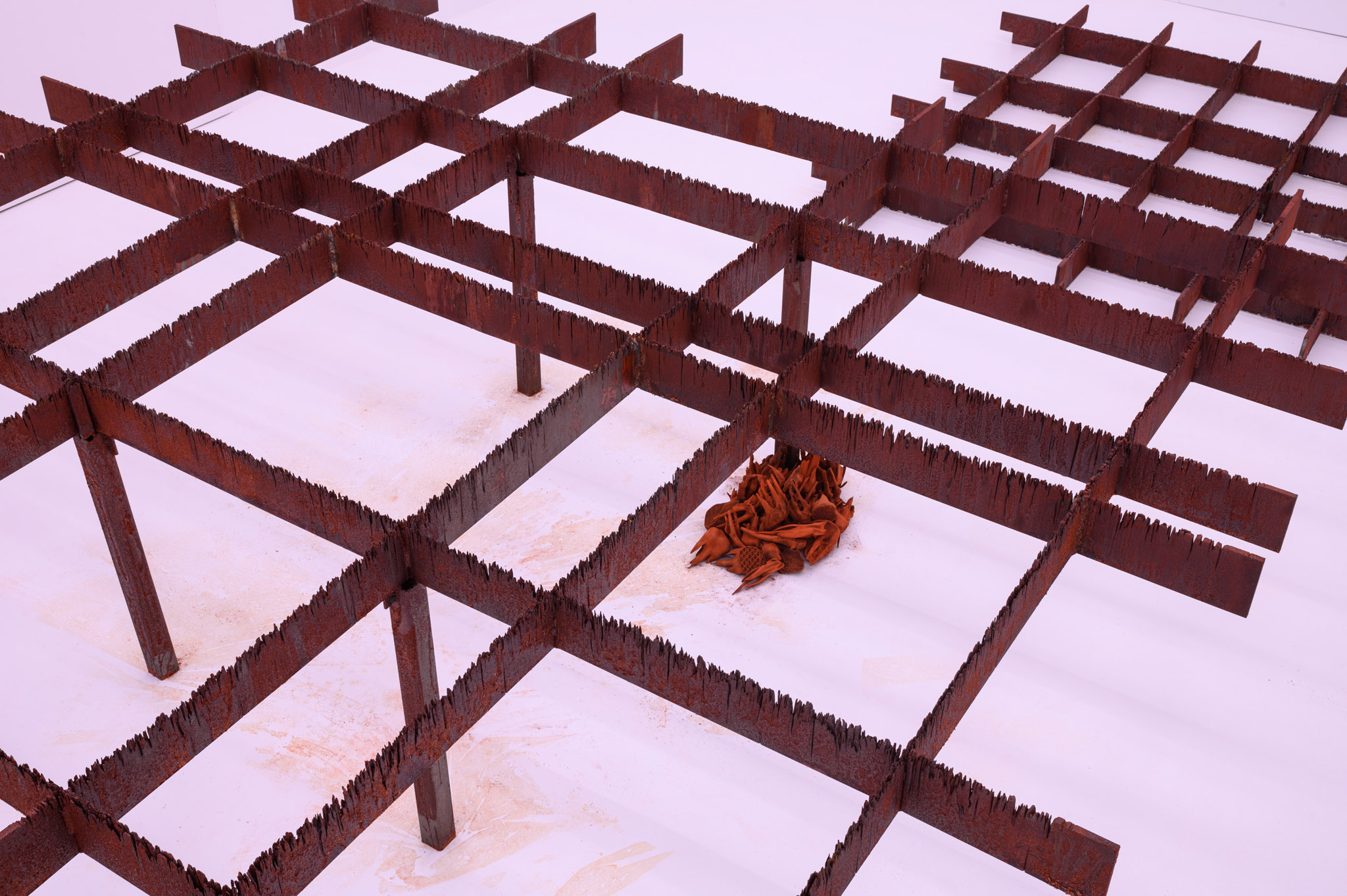
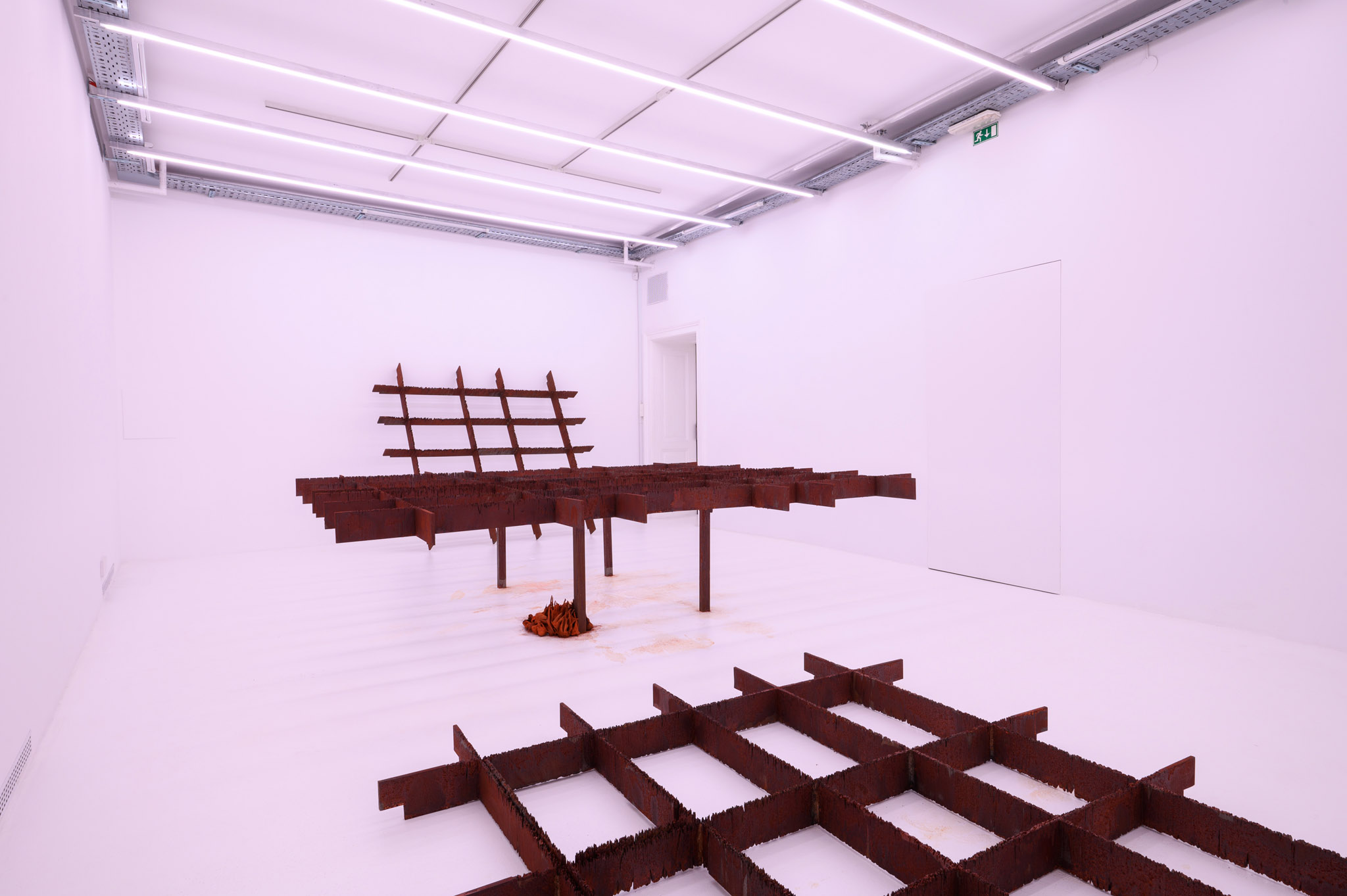
As metal turns to rust, so do the barriers of time give up their consistency once they are reduced to the strata that make up the ground we walk on. All known worlds and timelines inevitably become flat.
Downward direction is key, as the exhibition points underground, connecting the works through speculative tunnels, currents of soil-shifting and infrastructures of extraction. The breached layers of earth reveal remnants of abandoned divisions, currencies of unfamiliar lineage and scale, all relics of arrested growth that graze the sight of the present, replicating behind the observers’ retinas and nerve endings like topological hijackers entrusted to carry through what had been abruptly left on permanent hold. The depths obscure only what is seemingly too dangerous or threatening to be perceived on its own – at full scale, in a definition that reveals, even if slowly, progressively, the ratio of its conception and design.
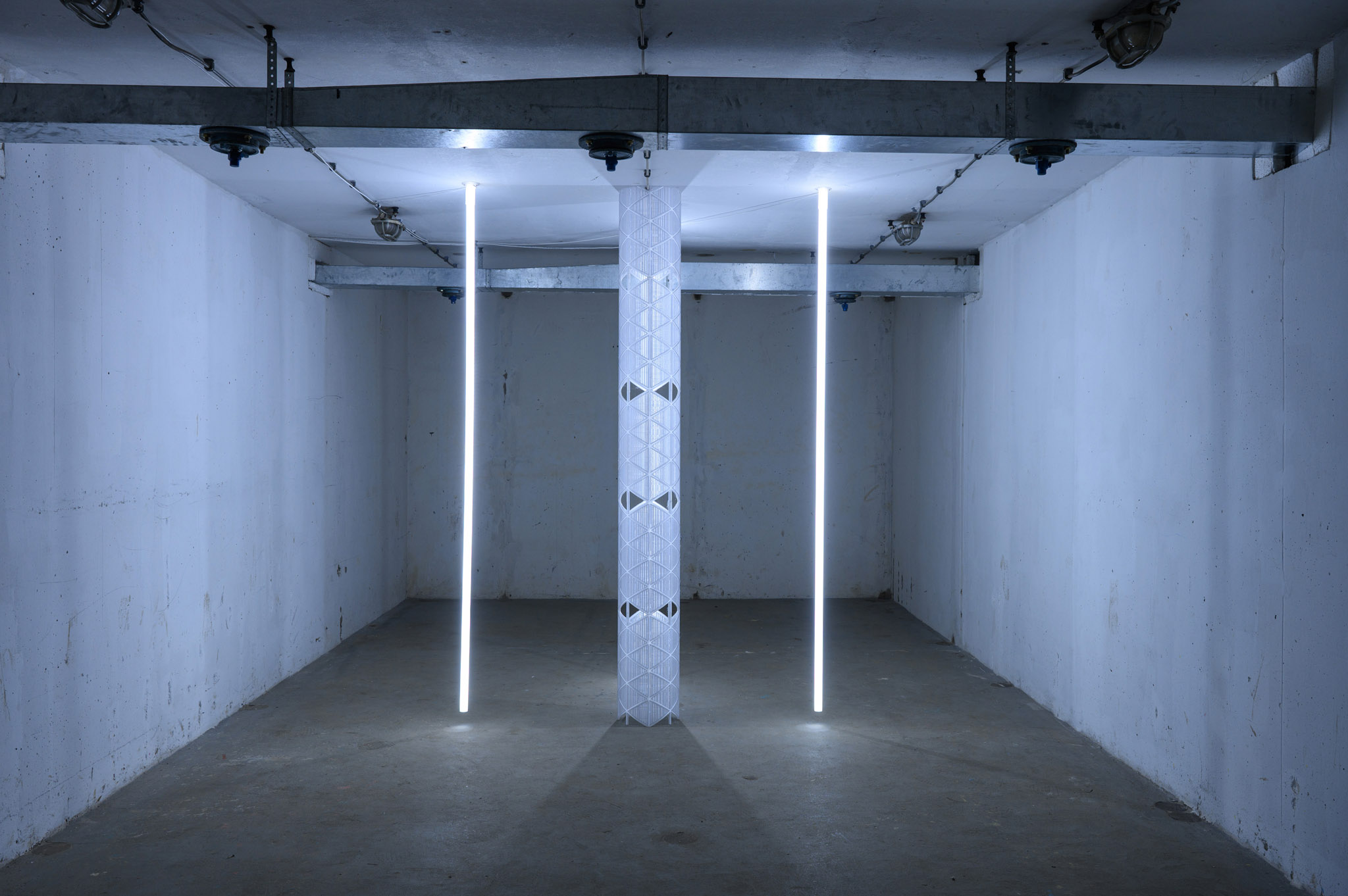
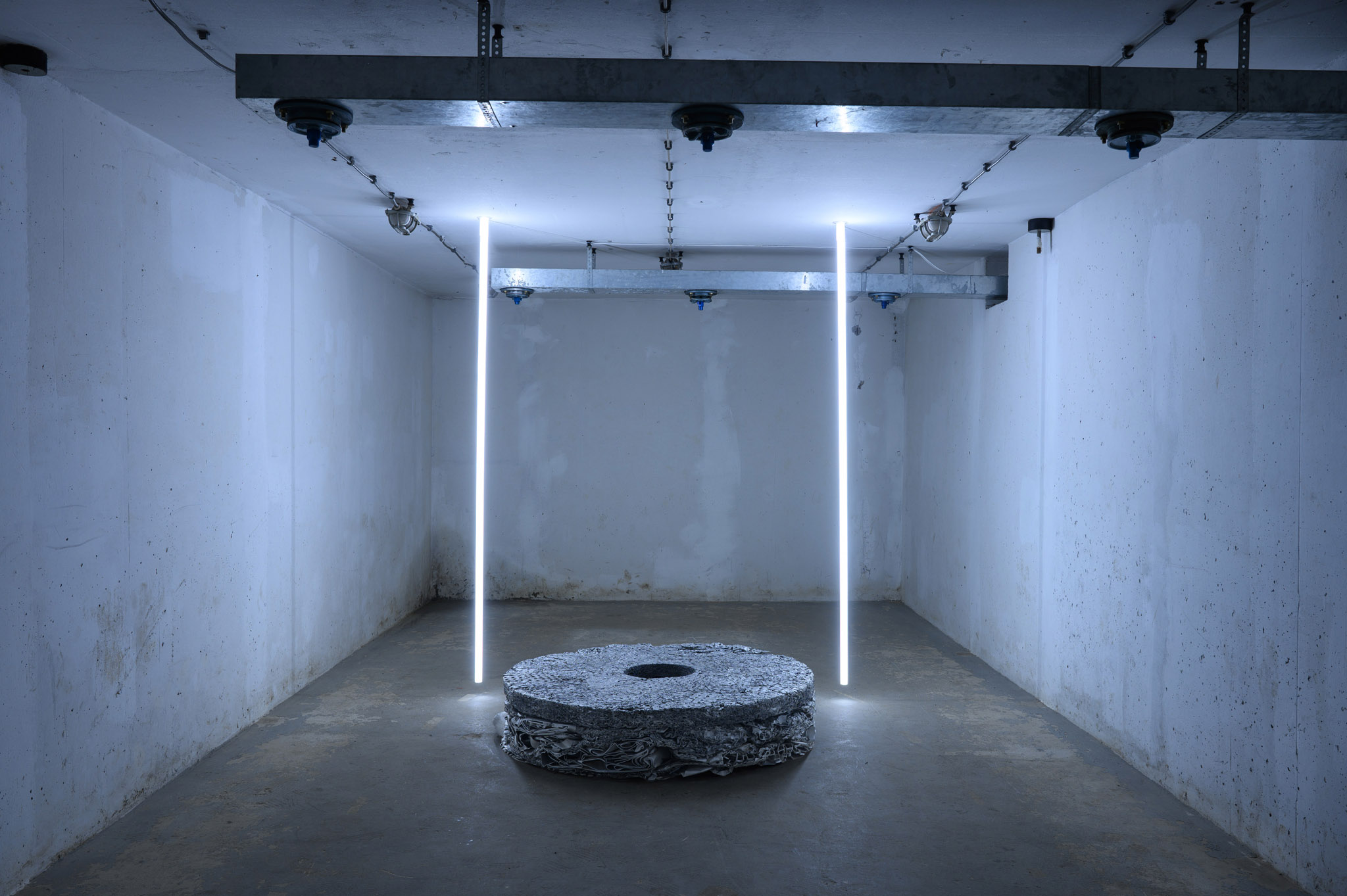
By venturing underground, the exhibition takes advantage of fractured phenomenality, exploring settings where light does not aid sight but hinders it. Overexposed white spots and swallowed edges; in the dark, things get clearer. Darkness could very well be the original abstraction, reducing the clutter of visual sensorium to its absolute minimum. Shapes form at the threshold of imagination, splitting the cognitive apparatus and merging it with its transcending otherness.
In the pitch black, the existing and the perceived align.
The paranoid ambiguity of physical presence uproots the unreliability of vision and reinstates it as material inscription rather than appearance. To an outside observer, the sites might seem riddled with displacement: that of the works, their ascribed meaning (the symbolic frame or mesh from which they originate – any attempt at comprehension is met with pushback, a shift in the works’ noetic grounding), as well as that of soil and air, of ions, oxidising and morphing the traces of iron into bleeding patches of rust and debris. The effects of displacement, however, wane as one descends deeper.
Amidst the thick matter, nearing ever closer to the molten core, the works emerge as autonomous signs – intricate webs of strategies, knowledge and ambitions – in those sticking around long enough, at depths deep enough. In these conditions, the philosophical analogy of the cave or crevice (or in contemporary terms, a mine or a shelter) loses its established meaning as an analogy of confusion and begins to function as a space of noetic respite instead. A space where reason moulds its own conditions rather than sourcing them out of appearances and pre-existing forms.
The exhibition was developed within the U30+ programme for supporting young artists.
Živa Božičnik Rebec graduated in 2014 in Unique Design – Glass and Ceramics from the Academy of Fine Arts and Design in Ljubljana, where she also studied for a master’s degree in sculpture. Her works have been exhibited in Slovenia and abroad in such venues and events as Nova pošta (2022), 34th Ljubljana Biennale of Graphic Arts Iskra Delta at The International Centre of Graphic Arts (2021), Museum of Contemporary Art Metelkova (2019), Triennial of Contemporary Art at the Museum of Modern Art (2019), Škuc Gallery (2018), Simulaker Gallery (2017), Cmurek Castle (2015) and Fashion/Art Toronto international exhibition in Toronto, Canada (2014). In 2019, she was an artist in residence at the Karlin Studios (Centre for Contemporary Art FUTURA, Prague).
 emaograjensek