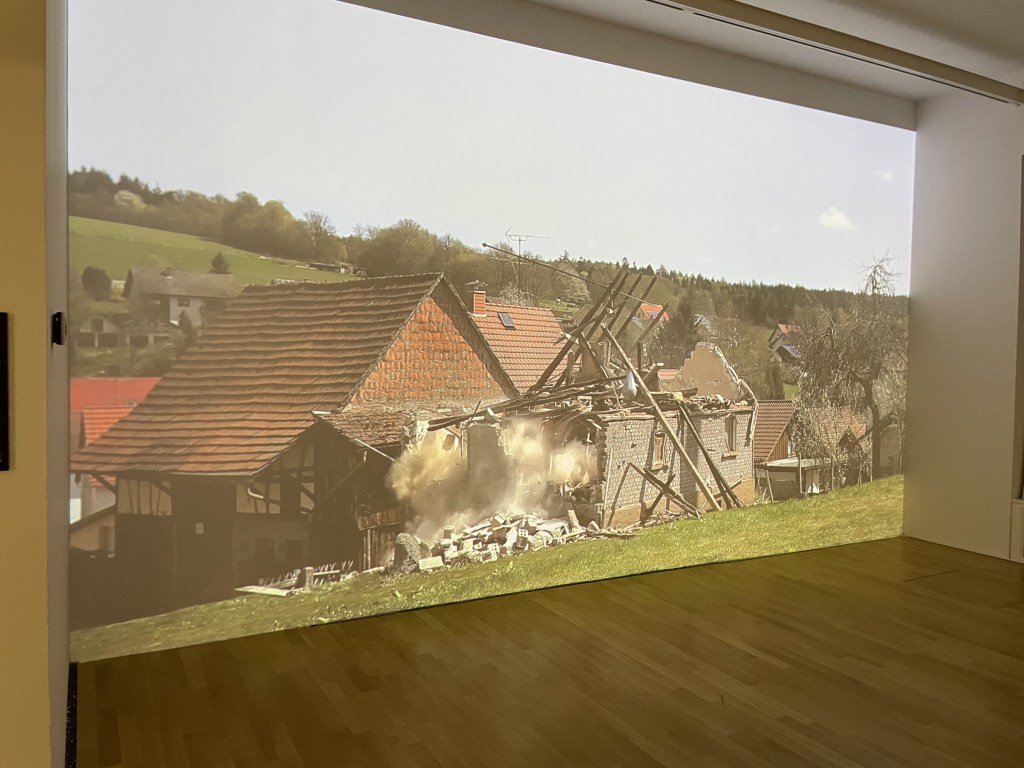
Featured image: Michael Sailstorfer, Tears (Tränen), 2015, video, 8’33”.
With works by Honza Zamojski, Michael E. Smith, Nina Koželj, Matej Stupica, Silvo Šarić, Meredith Monk, Pamela Rosenkranz, Neja Zorzut, Jon Derganc, Zdenka Pandžić, Nikola Ukić, Viktor Bernik, Nika Špan, Vadim Fiškin, Saša Spačal, Johannes Esper, Maks Bricelj, Michael Sailstorfer, Staš Kleindienst, Adam Vačkar, Gašper Kunšič, Mladen Stropnik
THE END is here, the international group exhibition curated by Vladimir Vidmar at the Museum of Contemporary Art Metelkova in Ljubljana asks what life in end times looks like and what end we are experiencing. The thesis of the exhibition is that the end is not something that is coming, but something that is already here, and that rather than illustrate and chronicle the end times, the exhibition aims to reflect and react to the current state of the world. The works are, therefore, presented in a symptomatic fashion, as bearers of tropes, concepts and affects that form the varied landscape of the exhibition experience. It is to learn, to feel, and to do so in a comparative and constructivist manner that awards access to what the exhibition has to offer.
The exhibition starts, and ends, with affect. Michael Sailstorfer’s video work Tears (2015) depicts a slow fall of tear-shaped objects, wrecking balls, demolishing domestic architecture in a seemingly suburban or rural setting. The video plays with documentary capture and digital artifice, blurring the line between reality and fiction, between pragmatic demolition and poetic catharsis. The work is introduced as a tool, an affective palette cleanser for the start or end of the exhibition, depending on the route the viewer takes when going through the show.
Additionally, the affective modality of the exhibition can be traced in works like Saša Spačal’s The Library of Fallen Tears (2022) that finds itself in a similar structural and positional role to Sailstorfer, highlighting its affective capacity to introduce or conclude. The Library of Fallen Tears is a sculptural installation, presented in the shape of a tear, with glass ampoules filled with microorganisms sourced from dehydrated tears. The installation is clean and distant, taking on the aesthetics of sterility of the scientific or pharmacological milieu with its late capitalist glow, while also being soft and vulnerable, incorporating the malleability of sand and cool LED lighting evoking a contemplative atmosphere between melancholy and serenity, instilling the installation with affective complexity. As well as in works like Tired Hands (2023) by Gašper Kunšič, a structured symbolic depiction of a pair of extending hands in bold red, white and blue that draws from various ornamental traditions in architecture and folklore. Kunšič approaches intimacy and feeling with the bold aesthetics and symbolism associated with the cultural artefacts of nation building (i.e. flags, monuments, etc.), extending the interiority of the personal into the macro scale, at which its affective building blocks can be more easily untangled.
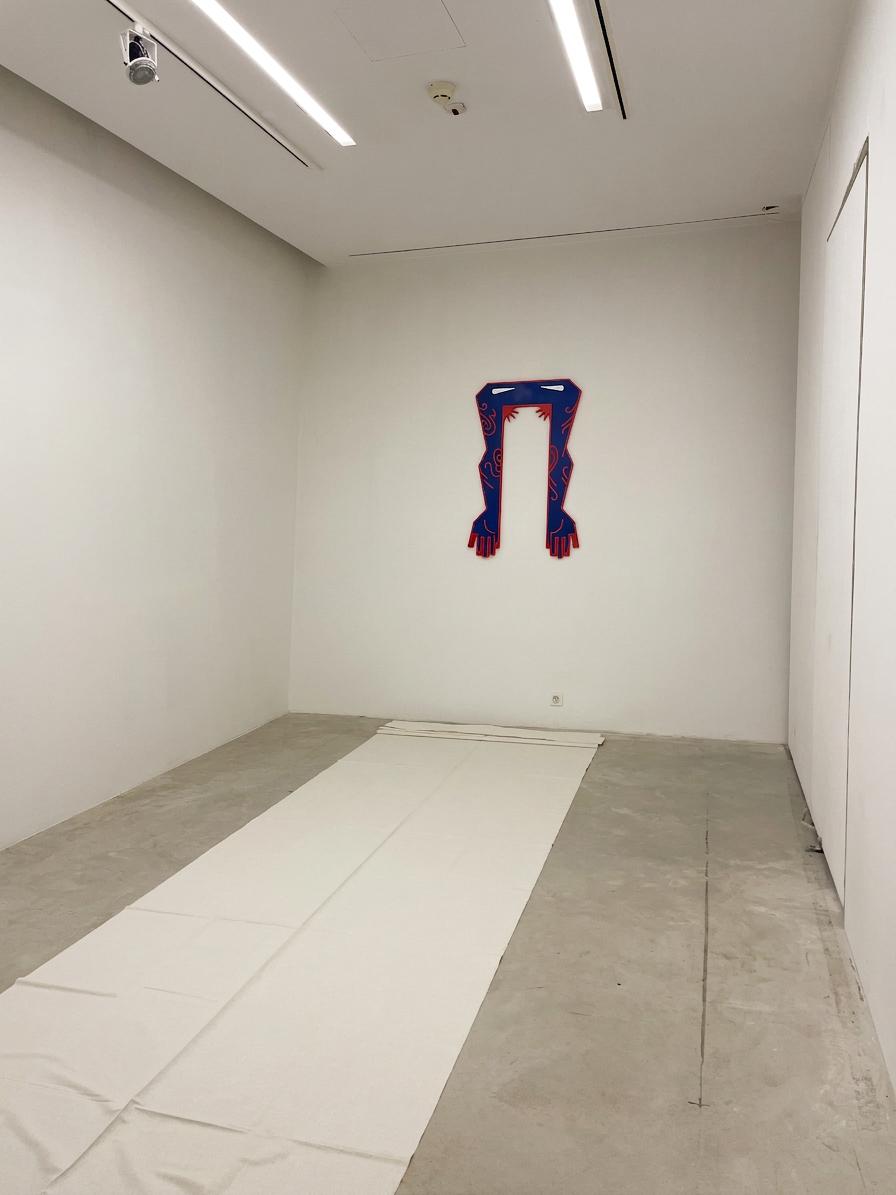
The role of such modality seems to be in establishing an ecology of moods and attitudes with which direction is possible. End times bring with them their own specific opacity, obscuring sight, and causing difficulty in orientation. It would be rash to jump to answers, when the questions haven’t (can’t?) been posed yet. Hence, a necessary clearing of the heart (and head).
Juxtaposed with Kunšič’s Tired Hands is the work of Jon Derganc entitled Shroud (2026). The appropriated cloth bears the discoloured marks accumulated through the extended period of non-use; as such, it makes visible the passing of time, its invisible presence, positioning it in relation to the evidentiary nature of religious and historical artefacts like death cloths. With works like Shroud the exhibition aligns its affective ecology of the end with the phenomenology of the trace, of things progressively disappearing or making themselves painfully apparent.
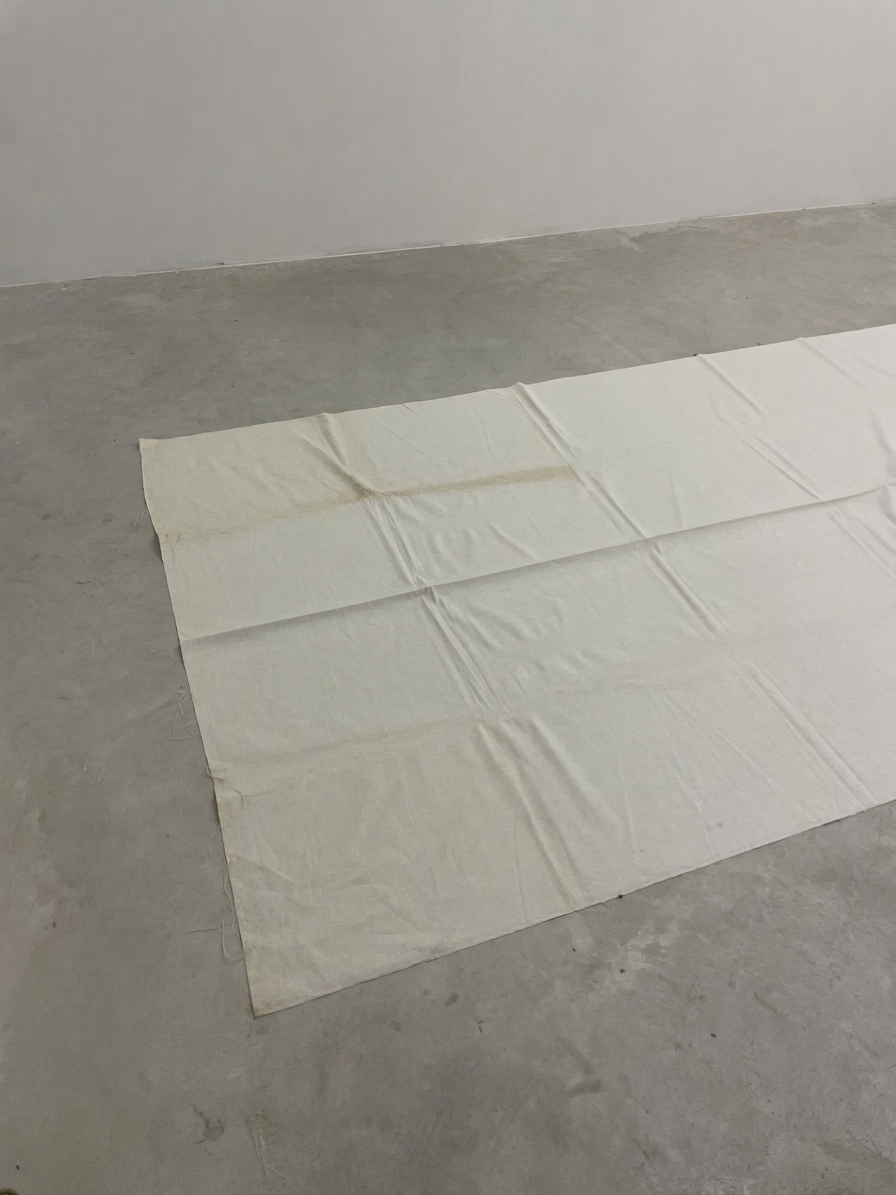
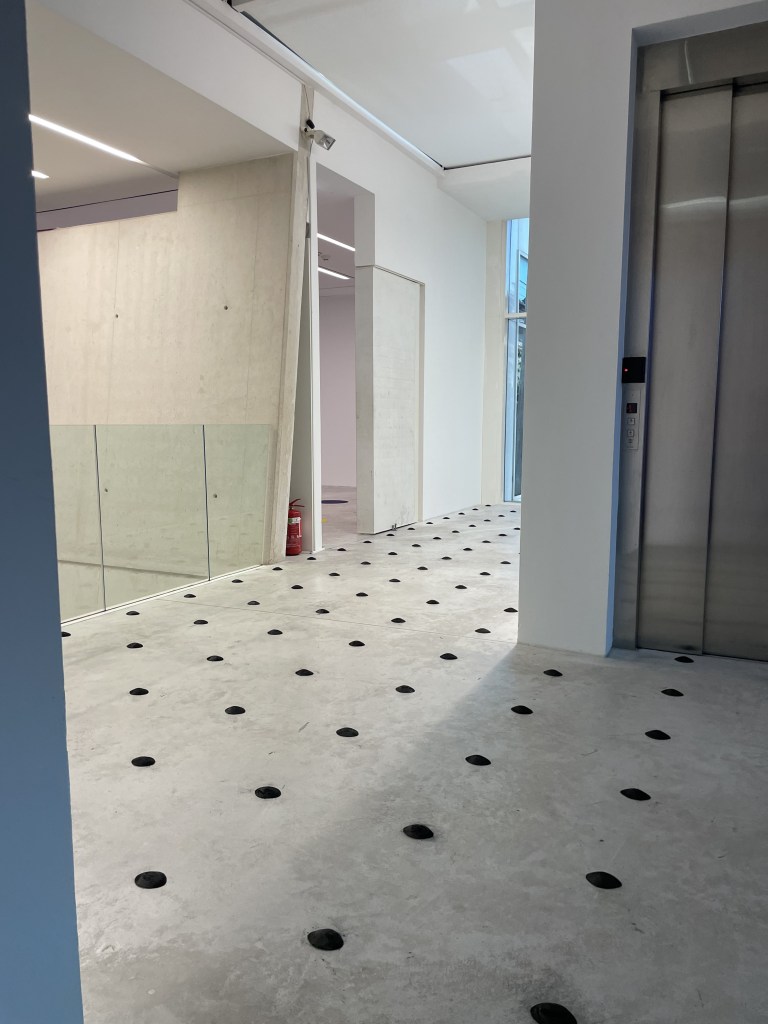
Trace, as a symptomatic trait, functions within the exhibition as a stand-in for the transitory reality of humanity and its environment. It provides a material foundation, based on which modes of pessimism and optimism can give way to alternate modalities that can help better process the affective oscillations of contemporary times. It can similarly be discerned in the works of Silvo Šarić and Neja Zorzut. Šarić works with light-sensitive phosphorous pigment to create fleeting impressions of shadows cast by interval flashes of light, whereas Zorzut’s Scorched Field (2026) utilises the physical process of burning to transform semi-spherical pieces of wood into spatially distributed objects kept in half-states of preservation and deterioration, opting for explicit material explorations that sidetrack perception and its phenomenological inquiries.
Bearing such traits, the exhibited works — more than isolated conceptual/aesthetic units — are made to serve an epistemic and didactic role. They escape their reified presence, spilling into one another and thus capturing and presenting the thesis of the exhibition, revealing a methodology akin to that of psychoanalysis. They act, labour, and reveal, comprising their own rhythm of disclosure — exemplified by the uncanny atmosphere of Meredith Monk’s 1983 sound, dance, and video work Turtle Dreams (Waltz). They also reveal art’s increasingly malleable nature: its ability to occupy disparate modes without dimming their conceptual/material intent — calling for an adaptive and daring curatorial framing that can match their ‘end-times’ resolve.

