Originally published in Slovene.
Translated excerpt:
“In 2001, Australian pop sensation Kylie Minogue released her eighth studio album, together with the single Can’t Get You Out of My Head, a track that would come to define the pop sound of the decade. Both the album and the single initially faced a risk similar to that encountered by Mariah Carey’s Glitter: their release coincided with the events of 11 September 2001, a circumstance that severely affected the commercial performance of many contemporary pop releases. However, unlike Glitter, Minogue’s release avoided the same fate because its rollout was staggered internationally—appearing on 8 September 2001 in Australia, 17 September in the United Kingdom, and only on 18 February 2002 in the United States.
This delay contributed not only to the eventual success of the album and its lead single, but also to their role in bridging the paradigm of “sweet addictiveness”—introduced and popularised by the “teen pop” genre of the 1990s—into the cultural climate of the post-9/11 world. Within this shifting landscape, the narrative trajectory of contemporary pop figures such as Britney Spears appears to move from total devotion to the cult of pop consumerism (as exemplified by I’m a Slave 4 U, performed at the MTV Video Music Awards five days before the attacks) toward a more oppositional stance against the society of control, the pervasive governance of the music industry, and the media’s (over-)watchful gaze (as suggested by Overprotected, released three months later).
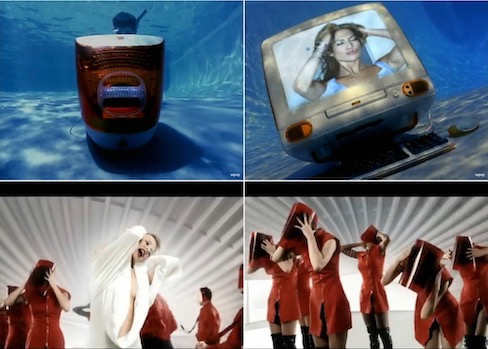
Such a transition aligns less with the wave of pop patriotism characteristic of the immediate post-9/11 cultural landscape and more with what Jennifer Chao describes as “oppositional culture,” associated with music projects critical of the contemporary American political order. Within this context, Can’t Get You Out of My Head occupies an intermediate position. The song fuses the pleasurable sweetness of being newly in love with an intrusive, almost agonising fixation that penetrates the core of teen-pop subjectivity. This intrusive dimension ultimately reveals itself as an intensified expression of the very pop addiction and devotion that structured American pop culture prior to 9/11. The accompanying music video underscores this duality: choreographed gestures of longing, paralysis, and obsessive repetition unfold against the serene brightness of what resembles an early spring day.
It is therefore not surprising that Can’t Get You Out of My Head is briefly discussed in Marc Couroux’s essay “Xenochronic Dispatches from the Domain of the Phonoegregore.” For Couroux, the coexistence of “sweet addictiveness” and what might be described as an agonistic invasion forms the conceptual nucleus of a broader theoretical shift from “ocular control”—the paradigm of surveillance associated with Jeremy Bentham and later elaborated by Michel Foucault—to what he terms “acoustic control.” Couroux’s text explores the mechanisms of a “technosonic control society” operating in the service of the “phonoegregore,” described as “an occult, corporate cabal seeking control over a given population through the use of schizophonic magick.”
Within this framework, popular music represents only one among many possible fields of application and dissemination. Can’t Get You Out of My Head serves primarily as a convenient illustration because the internal logic of its sonic construction is mirrored directly on its surface. What Couroux calls the “earworm”—a complex mechanism that can be understood as a biologistic analogue to the Deleuze-Guattarian “apparatus”—is already embedded in the title, the chorus, and the visual structure of the music video. It manifests as a loop that blurs the boundary between the implicit and the explicit. In doing so, it effectively resists attempts at critical exposure: making something visible belongs to the domain of the ocular, whereas the logic of “acoustic control” operates beyond such sensory limitations, functioning precisely through repetition, internalisation, and the involuntary persistence of sound.”